


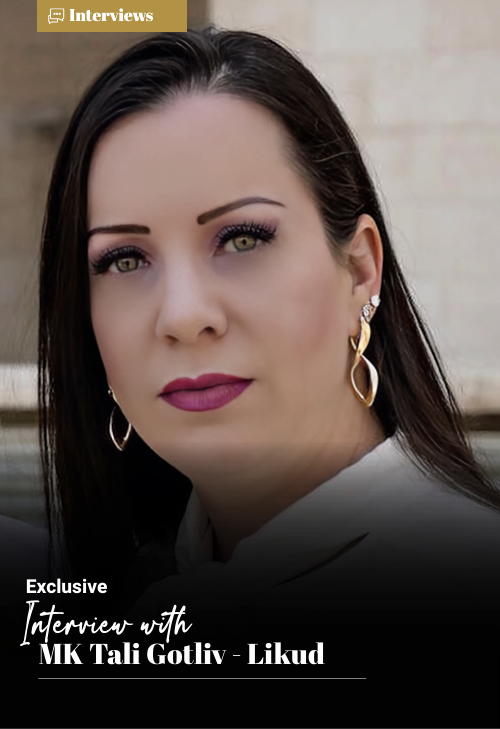
Greetings, and thank you for joining us. You were elected to the 25th Knesset as a representative of the Likud party, and since then, you have been a consistent and resolute voice in Israeli politics. Could you elaborate on how you balance your deep commitment to the Land of Israel and the Jewish people with your distinct stance within the Likud, particularly your non-alignment with the faction often described as “Bibist” [a term referring to staunch supporters of Prime Minister Benjamin Netanyahu]?
Knesset Member: Indeed, my primary motivation stems from my upbringing in a Religious Zionist household, deeply rooted in the ethos of my grandfather’s generation. For me, the Land of Israel is an inseparable part of our collective identity as Jews. It is not a matter open to debate or apology; it is as fundamental as the air I breathe. Equally clear to me is the unyielding hostility of our adversaries. The Palestinian ethos, as articulated by figures like Hajj Amin al-Husseini, the Mufti of Jerusalem—who, during the Holocaust, was honored by Hitler for his alignment with Nazi ideology—envisaged the annihilation of the Zionist vision. This adversarial stance persists to this day, albeit under different guises and names. I am unequivocal about the language we must use with such adversaries, and I reject what I term the “right-wing inferiority complex.” Right-wing values, which prioritize national resilience and deterrence, are not a liability but a necessity for our security. Regarding “Bibism,” I believe Prime Minister Netanyahu is a formidable leader who does not require adulation or sycophancy. I have critiqued certain policies when necessary, often positioning myself as a more right-leaning voice within the party. Over time, I have found the Prime Minister receptive to my perspectives, which are grounded in a nuanced understanding of the Middle East, our adversaries, and the diverse challenges surrounding Israel. A leader of his stature values constructive criticism over blind loyalty.
Interviewer: You mentioned the “right-wing inferiority complex.” Could you expand on this concept and its implications in the context of global progressive ideologies?
Knesset Member: Certainly. In the contemporary, progressive global discourse, which often dismisses notions of nationalism and sovereignty in favor of universalist values, right-wing ideologies are frequently stigmatized as retrograde. This worldview undermines the legitimacy of the nation-state, including Israel’s identity as a Jewish state. Historically, even during the Holocaust, certain leftist ideologies exhibited a tendency to appease adversaries or engage in conciliatory dialogue. I reject this approach. Our adversaries—exemplified by figures like Khaled Mashal of Hamas, who openly advocate for a single Palestinian state “from the river to the sea”—are not partners for negotiation. They seek our destruction. The progressive tendency to sanitize or rationalize such hostility is, in my view, a form of capitulation. This is why I advocate for a resolute stance that prioritizes national security and self-assurance over appeasement.
Interviewer: You’ve acknowledged that some left-leaning Israelis are Zionists who desire the state’s well-being. How do you reconcile this with your critique of certain leftist actions that you believe undermine Israel?
Knesset Member: Let me be clear: I do not claim a monopoly on Zionism. There are undoubtedly left-leaning Zionists who love Israel. However, true Zionism, in my view, precludes actions that defame the state or bolster our enemies. Those who falsely accuse Israel of apartheid in Judea and Samaria, for instance, are not acting as Zionists. By leveraging their titles or platforms to propagate such narratives, they provide aid and comfort to our adversaries, particularly during wartime. Zionism entails an unwavering commitment to the Jewish people’s right to this land as a sovereign nation-state. While Israel guarantees equal rights to all its citizens, it is fundamentally the nation-state of the Jewish people, not a state of all its citizens in the progressive sense. Those who blur this distinction risk undermining our core identity.
Interviewer: You’ve alluded to senior figures in Israel’s security and economic establishments who lean left, sometimes radically. How do you explain this phenomenon?
Knesset Member: When security officials, such as intelligence operatives, engage closely with adversaries—as exemplified by former Shin Bet head Ami Ayalon meeting Marwan Barghouti in Ramallah—they risk losing perspective. Barghouti never forgets that Ayalon is his enemy, but Ayalon, in empathizing with Barghouti’s perspective, may forget that Barghouti is a terrorist responsible for heinous acts. This dynamic reflects a broader issue: prolonged exposure to adversaries can lead to the assimilation of progressive ideas perceived as enlightened. Similarly, within the military, progressive agendas—such as prioritizing gender inclusivity over operational efficacy—can erode traditional values. For example, allocating resources to accommodate gender preferences in military facilities is, in my view, an overreach of progressive ideology. While I support individual freedoms, these should not supersede national security priorities. Progressive narratives, when unchecked, can compromise the moral compass of those in critical roles.
Interviewer: As a former Haredi soldier who served in the Golani Brigade and attended officer training, I was struck by the military’s emphasis on cultural assimilation over combat training. The stated goal was to create a “new Israeli” divorced from traditional values. Given the current debate over Haredi conscription, how do you address this tension?
Knesset Member: Haredi conscription is a matter of profound significance, akin to a sanctification of God’s name, especially in what I consider a war of existential necessity. However, the military must adapt to accommodate Haredi recruits without seeking to erase their identity. Just as I, from a Religious Zionist background, value my brother—a battalion commander—who prays at dawn with tefillin while armed, I want Haredi soldiers to remain Haredi. The military has established Haredi combat units to ensure that conscription respects their religious observance, including strict kosher standards and access to synagogues. The goal is not to produce a homogenized “new Israeli” but to integrate Haredim as proud contributors to national defense while preserving their values. Progressive agendas within the military, which sometimes alienate both Haredi and Religious Zionist communities, must be curtailed. The solution lies in appointing senior officers who share these values and prioritize victory and deterrence over ideological conformity.
Interviewer: You’ve been vocal about confronting what you term the “deep state” within Israel’s institutions, including the military and judiciary. Could you elaborate on your efforts, particularly your response to being summoned for investigation?
Knesset Member: As a Knesset member, I enjoy legal immunity for actions and statements made in the fulfillment of my duties. When I was summoned for investigation, it was an attempt to intimidate and silence me. I refused to comply, citing my immunity, which protects against both criminal liability and legal proceedings, including investigations. As a former criminal defense attorney, I am well-versed in the law and challenged the authority of the State Attorney’s deputy, who improperly contacted me—a potential suspect—despite lacking investigative powers. In a Knesset speech, I publicly rebuked this overreach, calling it audacious. My actions disrupted the status quo, exposing attempts by bureaucratic elites to suppress dissent. By leveraging my legal knowledge and public platform, I’ve challenged entrenched power structures, from the Shin Bet’s questionable decisions to judicial overreach, demonstrating that elected officials can reclaim authority from unelected functionaries.
Interviewer: Turning to the events of October 7, 2023, you accused the Shin Bet head of releasing the director of Shifa Hospital to conceal information. Could you clarify this claim?
Knesset Member: When the Shifa Hospital director, a senior terrorist operative, was released, the initial explanation was a lack of prison capacity. As a former defense attorney, I know that prison regulations prohibit releasing unconvicted detainees like him for such reasons; only sentenced prisoners convicted of minor offenses can be released under capacity constraints. When I pressed Defense Minister Yoav Gallant, he denied responsibility, revealing that the release was authorized by the Shin Bet under emergency wartime protocols. The Shin Bet later claimed it was a clerical error, but this contradicts their earlier statement. This pattern of deception suggests an intent to obscure the director’s knowledge about terrorist activities, including the presence of hostages in his hospital. Such actions undermine public trust and national security.
Interviewer: Where is the accountability from senior leadership— the Prime Minister, the Defense Minister, or the Minister of National Security?
Knesset Member: The Prime Minister directly oversees the Shin Bet but cannot monitor every decision in real time. When the Shin Bet head attributed the release to a subordinate’s error, he evaded responsibility. In my view, this warranted immediate dismissal, but I am not the Prime Minister. Leaders rely on trusted officials, and when those officials act duplicitously, it exposes systemic flaws. Accountability requires empowering ministers who prioritize victory and appoint officials aligned with these goals, rather than perpetuating bureaucratic inertia.
Interviewer: As a final question, are Israel’s ongoing strikes against the Houthis in Yemen a prelude to confronting Iran, or do they reflect a politicized air force that may resist broader strategic directives, as seen in past instances of pilot refusals?
Knesset Member: The strikes on the Houthis are critical, demonstrating Israel’s precision and resolve to counter attacks. They are not merely preparatory but a message of deterrence. Regarding Iran, Israel must strike its nuclear facilities to prevent a genocidal regime, rooted in Ayatollah Khomeini’s ideology, from achieving nuclear capability. Iran’s strategic patience and media manipulation necessitate preemptive action for the sake of future generations. As for the air force, I dismiss concerns about politicization. Pilots who refuse to fly are not indispensable; we have ample capable personnel. Israel’s military must remain focused on existential threats, not internal ideological debates.
Interviewer: Thank you for your time and insights.
Knesset Member: Thank you.



Related Articles

Interview with Attorney Ephraim Dimri
Legal and Political Dynamics in Israel Interviewer: Good evening, Attorney Ephraim Dimri....

Leave a comment